Getting to Phuket is easy: its airport is Thailand’s busiest outside Bangkok, with direct flights from across Asia, the Middle East and Europe. Getting around is the part that surprises people. There is no island-wide bus network, taxis are expensive by Thai standards, and the beaches are further apart than they look.
The table summarises the options. Fares are rough guides from recent seasons — they change, so check current rates.
Ways to get around at a glance
| Option | Where it goes | Rough cost | Good to know |
|---|---|---|---|
| Phuket Smart Bus | Airport ⇄ Surin, Kamala, Patong, Karon, Kata, Rawai | Around 100 baht flat fare | Roughly hourly in daytime; slow but cheap |
| Airport bus | Airport ⇄ Phuket Town (Bus Terminal 1) | Around 100 baht | About 1–1.5 hours; daytime |
| Shared minibus | Airport → hotels at the main beaches | About 200 baht per person | Leaves when full; may stop on the way |
| Airport taxi / pre-booked car | Anywhere | About 800–1,000 baht to Patong; more to the far south | Fixed price; fastest door to door |
| Grab / Bolt | Anywhere | Varies; often a little below taxi prices | Bolt is usually cheaper; waits can be long outside the main towns |
| Blue songthaew | Phuket Town ⇄ each beach | About 30–50 baht | Daytime only; no beach-to-beach routes |
| Tuk-tuk (Patong) | Short hops | From about 200 baht | Agree the price first |
| Scooter rental | Self-drive | About 250–350 baht a day | Licence, insurance and safety caveats — see below |
| Car rental | Self-drive | From roughly 1,000 baht a day | Driving is on the left |
Arriving at Phuket International Airport (HKT)
The airport is in the north of the island, in Thalang district. International and domestic terminals are next to each other. After immigration and customs you walk into a hall of transfer desks; official taxi and limousine counters quote fixed prices by destination.
- Nai Yang: about 10 minutes
- Mai Khao: 15–20 minutes
- Bang Tao / Laguna: 30–40 minutes
- Kamala and Surin: 40–50 minutes
- Phuket Old Town: 45–60 minutes
- Patong: 50–70 minutes
- Karon and Kata: 60–80 minutes
- Rawai and Nai Harn: 70–90 minutes
Times stretch in the late afternoon and when it rains. If you land late or with children, a pre-booked private transfer with a fixed price is worth the small premium.
Arriving overland: the Sarasin Bridge
Phuket is joined to Phang Nga province on the mainland at its northern tip. Road traffic uses a pair of modern bridges; the original Sarasin Bridge beside them is now a pedestrian walkway. Long-distance buses from Bangkok (around 12–13 hours), Krabi, Khao Lak and Surat Thani arrive at Bus Terminal 2 outside Phuket Town.
Buses and songthaews
The Phuket Smart Bus runs between the airport and Rawai along the west coast, calling at the main beaches. It is the only practical bus for visitors and is fine if you are not in a hurry. Check the current timetable and payment methods on the operator’s site.
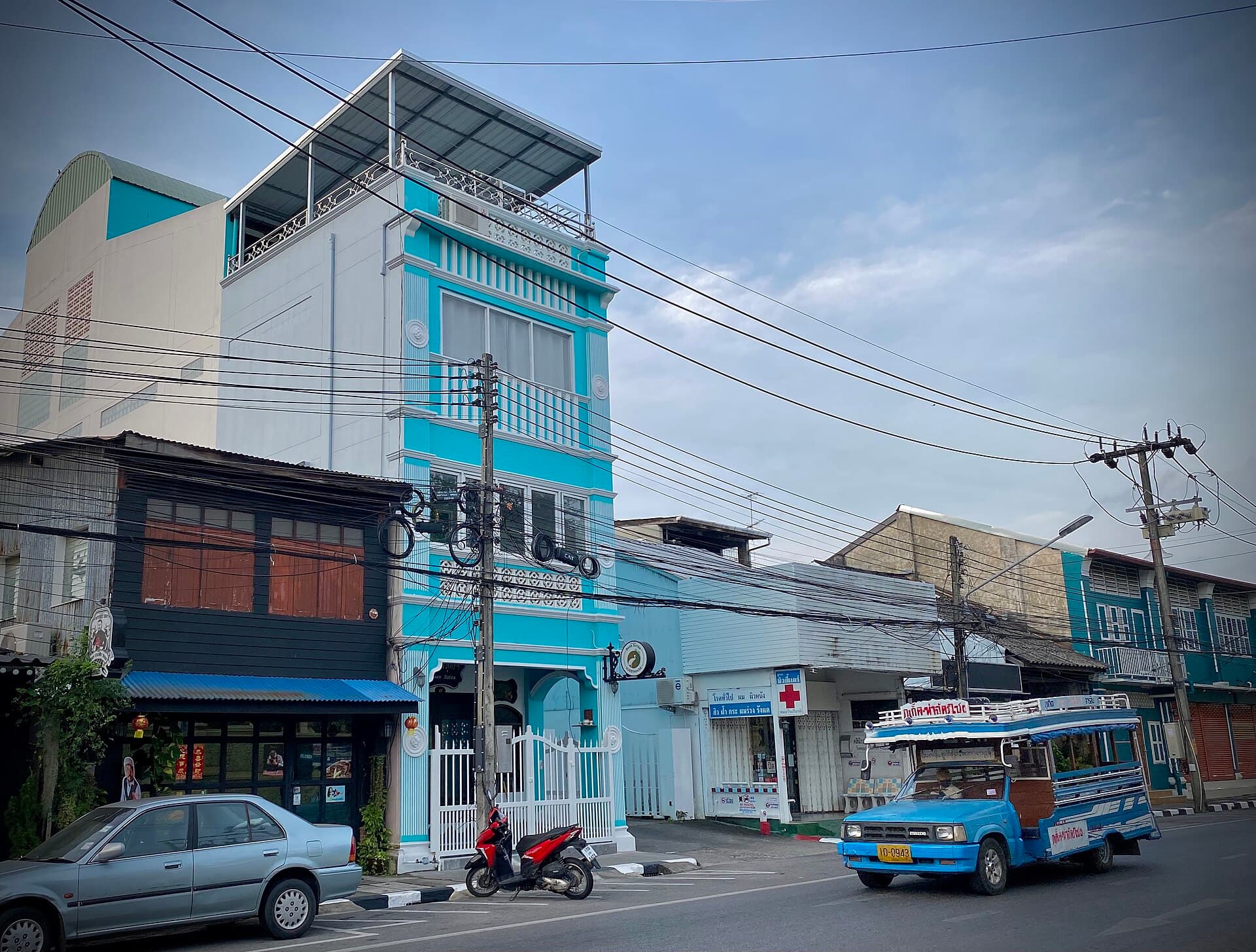
Blue songthaews — converted trucks with bench seats — fan out from Ranong Road in Phuket Town to Patong, Karon, Kata, Kamala, Rawai and other beaches from early morning to late afternoon. They are cheap and a little slow, and they only run to and from town: to go from Kata to Patong by songthaew you would change in Phuket Town.
Taxis, apps and tuk-tuks
Metered taxis exist but meters are rarely used; in practice every ride is a quoted price. Ride-hailing apps — Grab and Bolt — show the fare before you book and are now the simplest way to move between beaches. In Patong the red tuk-tuks (really small vans) charge by the trip, not the distance. Whatever you take, agree the fare before you set off.
Renting a scooter: read this first
Scooters are everywhere, cheap to rent and the cause of most serious tourist injuries on the island. Before you take one:
- Licence: you legally need a motorcycle licence valid in Thailand — in practice your home motorcycle entitlement plus an International Driving Permit. A car licence does not cover it. Police checkpoints fine riders without one.
- Insurance: most travel insurance will not pay medical bills if you ride without the right licence or without a helmet. Rental scooters usually carry only minimal compulsory cover.
- Helmet: compulsory for rider and passenger, and enforced.
- Roads: the hill roads between beaches are steep, winding and slippery in the rain. If you have never ridden, Phuket is not the place to learn.
- Deposit: never leave your passport as security. Offer a photocopy and a cash deposit, and photograph the bike before you ride away.
Piers and marinas
- Rassada Pier (Phuket Town) — ferries to Phi Phi, Krabi and Koh Lanta.
- Chalong Pier — boats to Racha and Coral Island, and dive boats.
- Bang Rong Pier (north-east) — boats to Koh Yao Noi and Koh Yao Yai.
- Ao Po and the east-coast marinas — Phang Nga Bay tours and many speedboat trips.
- Thap Lamu Pier (Khao Lak, mainland) — Similan Islands boats.
If you book a tour, the transfer to the right pier is almost always included.
Moving on from Phuket
Krabi, Railay and Ao Nang are reached by direct speedboat across Phang Nga Bay in under two hours, by ferry via Phi Phi, or by road in around three hours. Khao Lak is about 1.5 hours north of the airport by car. Koh Phi Phi and Koh Lanta have ferries from Rassada Pier.